
If the only place roof water bothers you is the front step, you may not need a whole gutter system. A strip of flashing in the right spot can keep the doorway dry for a fraction of the cost.
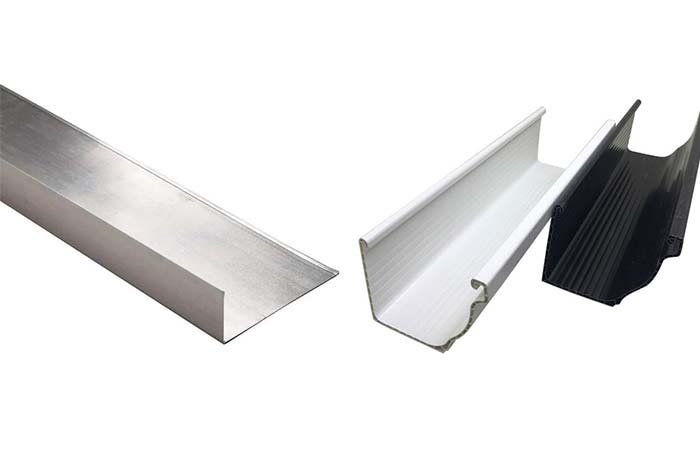
A rain diverter is a short piece of angled metal flashing slipped under the shingles above a door, path or window. It catches runoff and sends it off to one side. A gutter runs the full length of the roof edge and carries water to downspouts that discharge it away from the house. Use a diverter to protect one spot on a house without gutters, or to keep upper-roof water from pouring onto a lower roof. Use gutters when you need to protect the foundation, siding and basement.
Product links on this page are affiliate links. See our disclosure at the end.
Rain diverter vs gutter at a glance
| Rain diverter | Gutter | |
|---|---|---|
| What it covers | One door, path or short section | The whole roof edge |
| Where it goes | Under the shingles a few courses up | At the eave, on the fascia |
| Where the water goes | Off to one side, still onto the ground nearby | Into downspouts, discharged away from the house |
| Protects the foundation? | No | Yes, with extensions |
| Cost | A few dollars for flashing or a ready-made diverter | Several dollars per linear foot installed |
| DIY | Yes, on a low, walkable roof | Sectional kits yes; seamless is a pro job |
| Maintenance | Clear leaves and ice behind it | Regular cleaning |
What a rain diverter does

A diverter is usually an L-shaped strip of aluminum or galvanized steel. This Old House describes it as a simple piece of flashing, often the same material as drip edge, that runs under the shingles at an angle and acts like a mini gutter. Family Handyman suggests using D-style drip edge installed upside down, which comes in 10 ft lengths. You can also buy a ready-made aluminum rain diverter.
Diverters work on asphalt shingle roofs. On metal, tile and slate roofs, ask a roofer, since slipping flashing under those materials is harder and riskier.
How to install a rain diverter
- Measure and cut. Make the diverter at least 1 ft longer than the door on each side, as Gibraltar’s instructions and Family Handyman advise. Cut it with tin snips.
- Loosen the shingles. Working from a stable ladder, release the tabs in the second or third course up from the eave with a flat pry bar. On older, brittle shingles, lift only 2 to 3 inches.
- Slide it in at a slope. Push the flat leg under the shingles and tilt it toward the side you want the water to go. A Concord Carpenter says 3/4 to 1 inch of slope is enough for a 6 ft diverter.
- Nail it under the shingles. Place galvanized roofing nails where the shingles above will cover them, roughly every 2 ft.
- Seal everything. Dab roofing cement or a polyurethane sealant on every nail head and under the tabs, then press the shingles down.
- Test with a hose to check the water runs off the low end and not behind the diverter.
Our guides to ladder setup and working on a sloped roof cover safe access.
Rain diverter pros and cons
- Pros: cheap, quick to install, keeps entries dry and reduces icy steps in winter, keeps a clean roofline with no gutters
- Cons: protects only one area, sends extra water to the side, can trap leaves and ice behind it, and can let water under the shingles if it’s installed or sealed badly
Water still has to go somewhere. Make sure the end of the diverter doesn’t dump runoff against the foundation, a walkway or a neighbor’s property, and keep the ground there sloped away from the house.
When you need gutters instead

Choose gutters if water is reaching the foundation, basement or crawlspace, if runoff splashes onto siding all around the house, or if the overhang is short. Gutters with downspout extensions move water at least 5 ft from the foundation, as the DOE Building America Solution Center recommends. See our guides to gutter materials and gutter alternatives.
Rather not climb that high?
See what professional gutter cleaning costs in your area before you buy tools or rent a tall ladder. Free, no sign-up.
See local gutter cleaning prices →Rain diverter FAQs
Do rain diverters cause roof leaks?
Not when they’re installed correctly, nailed under the shingle tabs and sealed. Badly sealed nails or diverters that dam water can let it work under the shingles.
How long should a rain diverter be?
At least 1 ft longer than the door on each side, so a 3 ft door needs a diverter of about 5 ft.
Can I use a rain diverter with gutters?
Yes. Diverters are often used to steer water from an upper roof toward a gutter or away from a lower roof valley.
Related gutter guides
- Rain gutter alternatives
- How long do gutters last?
- Install gutters without a fascia board
- Why gutters matter
Sources: Family Handyman, add a rain diverter; This Old House, how to install a rain diverter; A Concord Carpenter, rain diverters; Gibraltar rain diverter instructions; DOE Building America Solution Center.
Affiliate disclosure: RoofScour is reader-supported. As an Amazon Associate we earn from qualifying purchases made through links on this page, at no extra cost to you. Product picks follow the criteria in the article, not commission rates.