
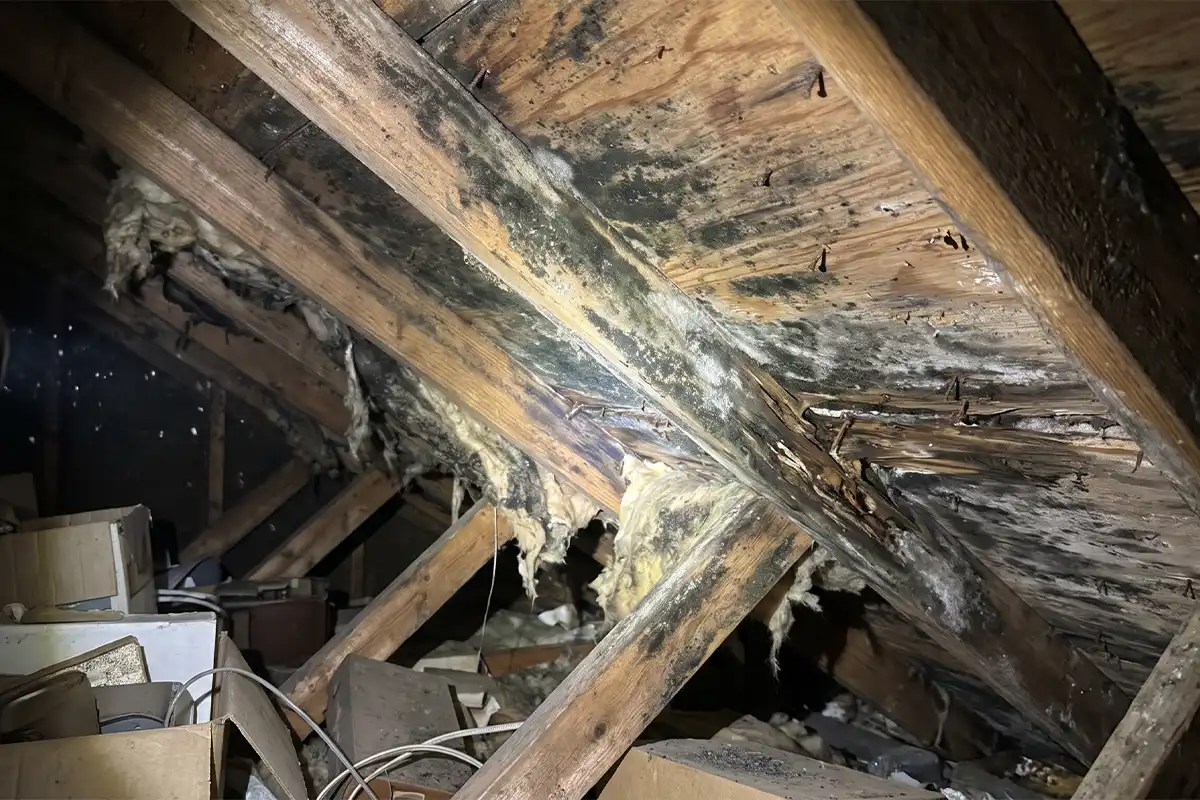
Attic mold usually goes unnoticed for years, because nobody goes up there. By the time someone spots black staining on the roof boards, the cause has often been running every winter for a long time.
Mold in an attic almost always comes from moisture: warm, humid air leaking up from the house and condensing on the cold underside of the roof, a bathroom or kitchen fan that vents into the attic instead of outside, blocked soffit vents, or a roof leak. Fix the moisture first, or the mold will come back. The EPA says a homeowner can usually handle a moldy area smaller than about 10 square feet (a 3 by 3 ft patch); larger areas, or mold tied to a lot of water damage, call for a professional. Attic mold removal typically costs $1,000 to $4,000, according to Angi.
Product links on this page are affiliate links. See our disclosure at the end.
Signs of mold in the attic
- Black, gray or white blotches on the underside of the roof sheathing or on rafters
- Dark staining that’s heaviest on the north side of the roof or around fan ducts
- A musty smell in the attic or upstairs rooms
- Frost on nails and sheathing in winter, or rusty nail tips
- Damp, matted or discolored insulation
- Water stains on upstairs ceilings
A moisture meter helps tell an old, dry stain from wood that’s still wet. A cheap hygrometer left in the attic shows whether humidity stays high.
What causes attic mold
| Cause | What it looks like | Fix |
|---|---|---|
| Bath or kitchen fan venting into the attic | Heavy growth in a patch around a duct end | Duct the fan outdoors through the roof or wall |
| Air leaks from the house | Widespread staining or frost across the roof deck | Seal gaps around lights, pipes, wiring and the attic hatch |
| Blocked or missing ventilation | Growth along the eaves and lower roof, stale damp air | Clear soffit vents, add baffles, balance intake and exhaust |
| Roof leak | A defined wet patch below a vent, chimney or skylight | Repair the leak |
| Ice dams | Wet sheathing and insulation at the eaves after snow | Air seal and insulate; remove dams safely |
| Dryer vented into the attic | Lint, heavy moisture near the duct | Vent the dryer outdoors |
Fans venting into the attic
This is one of the most common and easiest causes to fix. The DOE Building America Solution Center advises checking in the attic that bathroom and kitchen exhaust fans vent outdoors, and shows examples of mold growing on sheathing above a fan duct that dumps air into the attic. Run each duct to a roof or wall vent cap with insulated, sealed ductwork.
Air leaks and ventilation
In winter, warm indoor air carries moisture up through gaps around recessed lights, plumbing stacks, wiring holes and the attic hatch. When it hits the cold roof deck, it condenses. Air sealing those gaps does more than adding vents. Make sure insulation isn’t blocking the soffit vents; rafter baffles keep an air channel open from the eaves.
Roof leaks and ice dams
A leak shows up as a defined wet area below a roof penetration rather than a broad pattern. See our guides to finding a roof leak, common leak causes and ice dams.
How to remove a small patch of attic mold
If the area is under about 10 square feet, the wood is sound, and nobody doing the work has asthma, allergies or a weakened immune system, you can clean it yourself. Follow the EPA guidance:
- Fix the moisture source first. Cleaning without fixing it is wasted effort.
- Protect yourself. Wear an N95 respirator, goggles without vent holes and long gloves, as the EPA recommends.
- Scrub the surface with detergent and water, then dry it thoroughly. The EPA says biocides such as bleach are not recommended as a routine practice in mold cleanup.
- Bag and remove moldy insulation and other porous materials you can’t clean.
- Dry the area and keep checking it. If the mold returns, the moisture problem isn’t solved.
Mold on roof shingles outside is a different problem. That’s usually algae, and our algae removal guide covers it.
When to call a mold remediation pro
- The growth covers more than about 10 square feet, as is common in attics.
- The sheathing is soft, delaminated or rotting.
- There was a lot of water damage, such as a long-running leak.
- The mold keeps coming back after cleaning.
- Anyone in the home has asthma, allergies or a weakened immune system.
- You’re selling the house and need documented remediation.
A good contractor will find and fix the moisture source, contain the attic, remove or clean the growth, replace damaged insulation and sheathing if needed, and explain what they did. Ask whether the price includes fixing the ventilation or fan ducts, or only the cleanup.
Rather have a pro handle it?
Roof cleaning means working at height with chemicals on a slippery surface. See what professional roof cleaning costs in your area before you buy the gear. Free, no sign-up.
See local roof cleaning prices →How much does attic mold removal cost?
| Job | Typical cost | Source |
|---|---|---|
| Attic mold remediation | $1,000 to $4,000 | Angi |
| Mold remediation, all locations | $1,222 to $3,751 (average $2,365) | Angi |
| Whole-house remediation | $10,000 to $30,000 | Angi |
| DIY cleanup of a small patch | Cost of protective gear and cleaning supplies |
This Old House notes that a small, easy-to-reach patch can cost as little as $1,000, while extensive mold in a cramped attic can reach $4,000. Replacing rotted sheathing or a lot of insulation adds to the bill, as do repairs to the roof or ventilation.
How to prevent attic mold
- Check every bath, kitchen and dryer vent runs outdoors.
- Air seal the attic floor, especially around lights, pipes and the hatch.
- Keep soffit vents clear and intake and exhaust vents balanced.
- Fix roof leaks quickly, and keep gutters clear to limit ice dams.
- Look in the attic at least once a year, ideally after winter. Our roof inspection checklist includes attic checks.
Attic mold FAQs
Is attic mold dangerous?
Mold can trigger allergies and asthma, and some people are more sensitive than others. The EPA advises anyone with health concerns to talk to a health professional before cleanup. Attic mold also signals moisture that can rot the roof deck.
Should I use bleach on attic mold?
The EPA doesn’t recommend bleach as a routine practice. Scrub hard surfaces with detergent and water, and remove porous materials you can’t clean.
Does homeowners insurance cover attic mold?
Coverage often depends on the cause. Mold from a sudden covered event may be included, while mold from long-term humidity or poor ventilation usually isn’t. Check your policy.
Can I just add more vents?
Vents help, but sealing air leaks and fixing fans that vent into the attic usually matter more. Adding vents without fixing the moisture source rarely solves the problem.
Related guides
- How to find a roof leak
- How to fix a roof leak
- Common causes of roof leaks
- How to clean algae off roof shingles
Sources: EPA, a brief guide to mold, moisture and your home; EPA, mold cleanup in your home; EPA, should I use bleach to clean mold?; DOE Building America Solution Center, check exhaust fans vent outside; Angi, mold remediation cost; This Old House, mold remediation cost. This guide is general information, not medical advice.
Affiliate disclosure: RoofScour is reader-supported. As an Amazon Associate we earn from qualifying purchases made through links on this page, at no extra cost to you. Product picks follow the criteria in the article, not commission rates.