
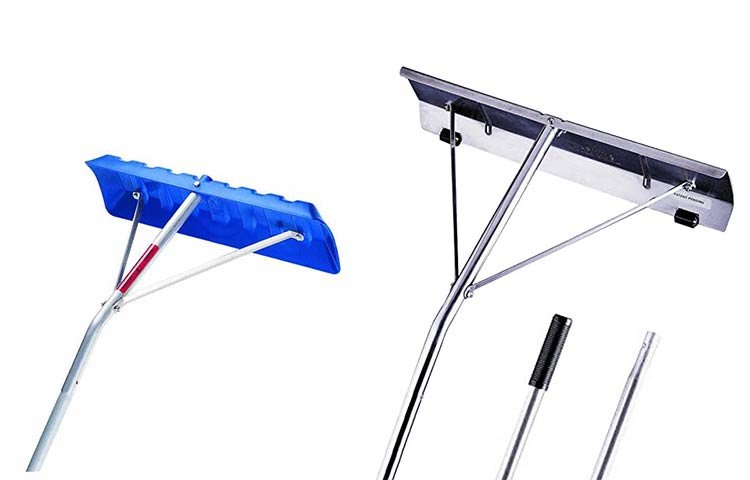
Heavy snow on a roof is a slow-motion leak. Snow melts over the warm part of the roof, refreezes at the cold eaves, and the ice dam that forms pushes water back under the shingles. A roof rake lets you pull that snow off from the ground before it gets the chance.
The best roof rake for most homes is the Snow Joe RJ204M: it reaches 21 feet, weighs 4.8 pounds and costs little. For roofs where you’re worried about shingle damage, pick a rake with rollers such as the Extreme Max 5600.3207 or the USA-made Garelick 89421. For tall or two-story roofs with heavy snow, a slide rake like the SnowPeeler 30 ft or Avalanche Original 500 moves snow faster with less effort. For leaves and pine needles, use a light rake head on a telescoping pole instead of a snow rake.
Quick picks: best roof rakes
| Rake | Type | Reach | Best for |
|---|---|---|---|
| Snow Joe RJ204M | Pull rake, poly blade 6 x 25 in | 6.2 to 21 ft telescoping | Most single and two-story homes; lightest pick |
| Extreme Max 5600.3207 | Pull rake with rollers, 24 in blade | 21 ft | Protecting shingles |
| USA Handy Tools (Garelick) 89421 | Pull rake with Shingle Saver rollers, 24 in blade | About 20 to 21 ft | Buyers who want a USA-made metal rake |
| SnowPeeler 30 ft | Slide rake with glide pads | 30 ft (six 5 ft poles) | Tall roofs, low-pitch roofs and heavy snow |
| Avalanche Original 500 | Slide system with 1.5 in wheels | 16 ft fiberglass pole | Fast clearing on asphalt shingle roofs |
| VEVOR 6 to 24 ft pole + DOCAZOO roof rake attachment | Rake head on a telescoping pole | 6 to 24 ft | Leaves and pine needles, not snow |
Product links on this page are affiliate links. See our disclosure at the end.
How to choose a roof rake
Pull rake or slide rake
A pull rake is a wide blade on a long pole. You push it up the roof, then pull a slab of snow down toward you. It is cheap, light and handles snow, leaves and debris.
A slide rake has a cutting frame and a long plastic or fabric slide. You push it up the roof and the snow it cuts slides down the chute and off the eave. Avalanche, which invented the design, says it takes much less effort than pulling. Slide rakes cost more and work best on asphalt shingles; Avalanche’s 500 model is not recommended for some metal roof designs, and its 750 model with 3-inch wheels is made for metal, shake, tile and solar.
Reach
You only need to clear the lower part of the roof. Avalanche recommends removing the first 5 feet of snow above the eaves, and Angi suggests clearing at least 5 to 6 feet from the edge. For most single-story homes, a 16 to 21 foot pole is enough; two-story roofs and deep overhangs need 21 to 30 feet.
Shingle protection
Rollers, wheels or glide pads keep the blade a fraction of an inch off the shingles, so you don’t scrape off granules. The University of Minnesota Extension warns that roof rakes can damage roofing materials, so rollers are worth paying for on asphalt shingles.
Weight and blade width
Light rakes around 5 pounds are easier to hold overhead for long sessions. Wider blades clear faster but pull heavier slabs of wet snow. A 24 to 25 inch blade is the common middle ground.
The best roof rakes, reviewed
1. Snow Joe RJ204M: best overall

The Snow Joe RJ204M uses a Twist-n-Lock telescoping pole that extends from 6.2 to 21 feet with no sections to assemble. The poly blade measures 6 by 25 inches, and the whole rake weighs 4.8 pounds, per Snow Joe (specs). It is light enough for long sessions and doubles as a leaf rake in fall. It has no rollers, so keep a light touch on shingles. The RJ205M version swaps in an aluminum blade at 5.7 pounds but has been discontinued at some retailers.
Pros: very light; no assembly; reaches most two-story eaves; low price.
Cons: no rollers; poly blade flexes in packed snow.
Check Snow Joe RJ204M on Amazon →
2. Extreme Max 5600.3207 Shingle-Saver: best for protecting shingles

The Extreme Max Shingle-Saver pairs a 24-inch aluminum blade with rollers that ride on the roof, so the blade never scrapes the shingles. The pole snaps together with push buttons and reaches 21 feet. All-metal construction makes it stiffer than poly rakes in heavy, wet snow.
Pros: rollers protect shingles; sturdy blade; 21 ft reach.
Cons: heavier than the Snow Joe; sections to assemble.
Check Extreme Max on Amazon →
3. USA Handy Tools (Garelick) 89421: best USA-made rake

Formerly sold under the Garelick name, the 89421 is a US-made aluminum rake with patented Shingle Saver rollers and a 24-inch blade on a sectional pole of about 20 to 21 feet. It’s a straightforward, durable pull rake for buyers who want metal construction and roller protection.
Pros: USA-made; Shingle Saver rollers; metal blade.
Cons: sectional pole takes longer to set up; higher price than imported rakes.
Check the 89421 on Amazon →
4. SnowPeeler 30 ft: best for tall roofs and heavy snow

SnowPeeler is a slide rake. Its tapered cutting frame slices through fresh and packed snow, and the 10-foot slide carries it off the roof. Six 5-foot poles give 30 feet of reach, and glide pads protect the roofing. It’s heavier, at around 13 pounds, but you push instead of pull, which is easier on your back with heavy snow.
Pros: longest reach here; slide moves large loads; glide pads.
Cons: heavier; slide rakes need practice; overkill for light snow.
Check SnowPeeler on Amazon →
5. Avalanche: slide system or classic rake

Avalanche makes two different tools. The Original 500 is a slide system with a 17-inch by 12-foot plastic slide, 1.5-inch wheels for asphalt shingles and a 16-foot fiberglass pole in four sections, about 10 pounds in total. The SnowRake Deluxe 20 (SRD20), pictured, is a conventional pull rake with a 24-inch poly head and a 20-foot handle; Acme Tools recommends it for clearing snow from solar panels.
Pros: slide system clears fast with little effort; SRD20 is US-made.
Cons: 500 model not suited to some metal roofs; slide systems cost more.
Check the Avalanche 500 on Amazon → · Check the SnowRake Deluxe 20 →
6. Suncast telescoping roof rake: budget pick

Suncast’s roof rake telescopes from about 7 feet to 21 feet and uses a resin blade on an aluminum handle. It is a basic, low-cost pull rake for occasional light snow. Keep it out of strong sun in the off-season, since the plastic parts age faster in UV.
Pros: low price; adjustable length.
Cons: no rollers; plastic parts less durable than metal rakes.
Check Suncast on Amazon →
Best roof rake for leaves and pine needles
Snow rakes are clumsy on leaves. For leaves, pine needles and light debris, pair the VEVOR 6 to 24 ft pole with the DOCAZOO roof rake attachment, which threads onto the pole tip. The pole extends from 6 to 24 feet and takes standard threaded attachments; check the thread type on both listings before you order. Rake gently with the slope; dragging tines across shingles can lift them and strip granules.
How to rake snow off a roof safely
- Stay on the ground. Never rake from a ladder. Falling snow can knock a ladder over.
- Look up before you start. Aluminum poles conduct electricity. Keep the rake well clear of service lines to the house and any overhead power lines.
- Start at the eave and work up. Clear the first 2 feet, then the next few feet behind it. Aim to clear at least 5 to 6 feet above the edge, per Angi and Avalanche.
- Take small bites. Thin slabs are lighter on your back and less likely to damage gutters or plants below.
- Leave a thin layer. Don’t scrape down to the shingles. Rollers help keep the blade off the surface.
- Stand clear of the drop zone. Work at an angle so snow falls beside you, not on you.
- Go easy around skylights and vents. Clear around them, not over them.
Raking treats the symptom. The University of Minnesota Extension explains that ice dams come from heat escaping into the attic and warming the roof, so air sealing and insulation are the long-term fix (UMN Extension). Our guide to gutters and ice dams covers more, and our roof and gutter heat cable guide explains when cables help and what they cost to run.
Rather have a pro handle it?
Roof cleaning means working at height with chemicals on a slippery surface. See what professional roof cleaning costs in your area before you buy the gear. Free, no sign-up.
See local roof cleaning prices →Roof rake FAQs
When should you rake snow off a roof?
Angi suggests raking after every 6 inches or so of snowfall to prevent ice dams. Rake sooner after heavy, wet snow, and whenever you see icicles thickening at the eaves.
Do roof rakes damage shingles?
They can. Scraping a bare blade across shingles wears off granules, and the University of Minnesota Extension warns rakes may damage roofing materials. Choose a rake with rollers or wheels, leave a thin layer of snow, and stop if the blade catches.
How long a roof rake do I need?
Long enough to reach 5 to 6 feet above your eaves from a safe distance. That is usually 16 to 21 feet for single-story homes and 21 to 30 feet for two-story homes.
Can I use a roof rake on a metal roof?
Yes, with care. Snow slides off metal readily, so stand well back. Avalanche recommends its 750 model, with 3-inch wheels, for metal, shake, tile and solar roofs instead of the 500.
Related guides
- How to remove snow from a roof
- Do gutters cause ice dams?
- How to clean gutters from the ground
- Best roof safety harnesses
- Best roof brushes and brooms
Updated November 2026. Sources: Snow Joe RJ204M specifications; Acme Tools, Avalanche snow removal system; Angi, What is a roof rake; University of Minnesota Extension, Ice dams; Star Tribune, Ice dams: how to prevent and remove.
Affiliate disclosure: RoofScour is reader-supported. As an Amazon Associate we earn from qualifying purchases made through links on this page, at no extra cost to you. Product picks follow the criteria in the article, not commission rates.